Birthing a Movement by Renée Ann Cramer
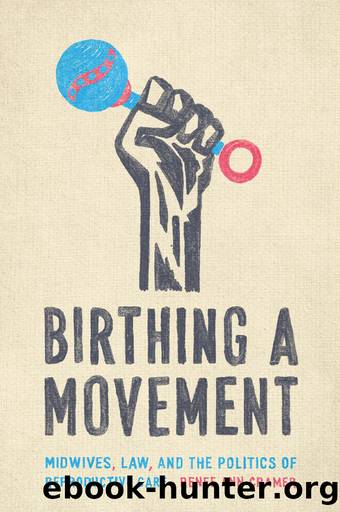
Author:Renée Ann Cramer
Language: eng
Format: epub, pdf
Publisher: Stanford University Press
Published: 2020-06-15T00:00:00+00:00
Even so, the outcomes of rulemaking vary tremendously from state to state. Differences abound around composition of the regulatory board, scope of practice, insurance requirements, eligibility for reimbursement, autonomous practice, and review of regulations. And, though midwives and advocates do not lack for models from around the country to consult for guidance, the language is often obfuscatory, alienating, and confusingârequiring, in some instances, both legal and medical translation.52 The effort is also worth it, though: Well-written regulations, midwives and researchers agree, can positively impact, âon a generational level, the quality of care.â53
Because it is easier to pass a bill that doesnât have details regarding practiceâand because passing bills that are vague usually means that constituents and midwives end up with better practice recommendations for safe out-of-hospital birthâmost state advocates seek bills that simply legalize and regulate, while deferring the work of rulemaking to after enactment. National advocates advise groups to write bills âusing boilerplate language for other professionals in your state, and just put CPM in thereâ or to take boilerplate language from other statesâ CPM legalization bills and âinsert your state.â54
This makes tremendous sense to get a bill passed, and to get midwifery regulated appropriately. But, as a Michigan attorney told us, âIt took us eight years to get a law in Michiganâand let me tell you, writing and passing a bill is a walk in the park, compared to rulemaking.â55 At this point in the process, though the rulemaking was accomplished by a committee that didnât include attorneys (at least not in their capacity as attorneys), legal expertise around regulatory policymaking was useful to have. Both legislative and administrative processes ânecessitate insider baseball,â but the former necessitated political savvy and interpersonal relationship building, the latter required knowledge of other statesâ regulatory bodies, combined with a deep understanding of the best practices for out-of-hospital birth attendants.56 A presenter at a MANA session explained that while the political process was winner-take-all and zero sum, at its best âRulemaking on regulations is consensus-based and evidence-based.â57 Rulemaking combines both legal and midwifery expertise.
Before the state can adopt rules for midwives and adequately regulate them, it must authorize a committee to make decisions. And even that decision is controversial. How many midwives will be on the committee? How many consumers? How many ob-gyns, labor and delivery nurses, and nurse-midwives? Should organizations who opposed the licensure bill have a seat at the table for rulemaking? Sometimes legislation outlines the composition of the study committee for rulemaking, oftentimes it does not. After the number and types of board members are decided, the question of specificity comes up. Which ob-gyn should serve? Which midwife? Which consumer?
To even get to the table can be exhausting.
Most midwives and advocates agree that the best board is one that is made up of people familiar with out-of-hospital birth, and certainly not made up of people hostile to the practice. Because a primary role of the governing board is to field and investigate complaints that are brought to it, it is
Download
This site does not store any files on its server. We only index and link to content provided by other sites. Please contact the content providers to delete copyright contents if any and email us, we'll remove relevant links or contents immediately.
The Secret History by Donna Tartt(19103)
The Social Justice Warrior Handbook by Lisa De Pasquale(12197)
Thirteen Reasons Why by Jay Asher(8918)
This Is How You Lose Her by Junot Diaz(6894)
Weapons of Math Destruction by Cathy O'Neil(6284)
Zero to One by Peter Thiel(5808)
Beartown by Fredrik Backman(5766)
The Myth of the Strong Leader by Archie Brown(5513)
The Fire Next Time by James Baldwin(5454)
How Democracies Die by Steven Levitsky & Daniel Ziblatt(5224)
Promise Me, Dad by Joe Biden(5157)
Stone's Rules by Roger Stone(5091)
A Higher Loyalty: Truth, Lies, and Leadership by James Comey(4966)
100 Deadly Skills by Clint Emerson(4931)
Rise and Kill First by Ronen Bergman(4797)
Secrecy World by Jake Bernstein(4756)
The David Icke Guide to the Global Conspiracy (and how to end it) by David Icke(4723)
The Farm by Tom Rob Smith(4517)
The Doomsday Machine by Daniel Ellsberg(4493)
